
Books about multiples
This page contains a number of book reviews that may be of interest to the multiples community and those interested in gaining insights into the lives of twins, triplets and more. Reviews include books by Nancy Segal, a prolific author who is a renowned psychologist specialising in the study of twins and is a twin herself. Topics covered include parenting multiples, the importance of twins and multiples to the research community, loss in a multiple pregnancy and insights into what it is like to grow up as a multiple. There is also a review of the book ‘Deliberately Divided’ where Segal discusses a thorny subject: the wilful separation of twins and triplets upon adoption in the 1960s-80s.
Have you read a good twin book? We always welcome reviews of books on twins or more that we can add to this page. Please get in touch if you have something to contribute (chair@icombo.org).
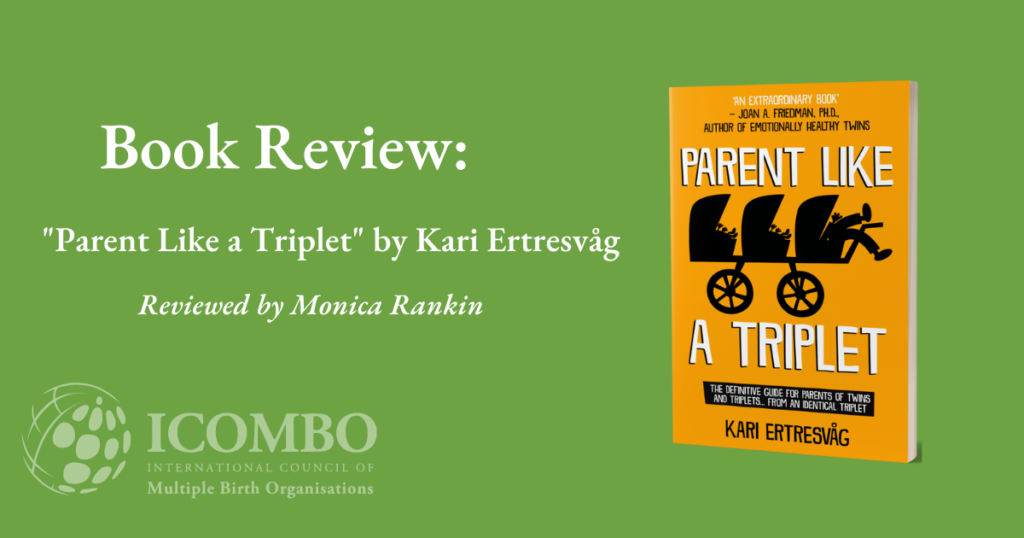
by Kari Ertresvåg
Review by: Monica Rankin
This book is a must-read for parents and parents-to-be of multiples. Kari is an identical triplet and the book is a rare first-person glimpse into what it’s like to grow up as a multiple It is an A-to-Z on how best to raise twins and triplets.
You will want to keep a copy on the bookshelf because you will find yourself going back to it many times as your multiples grow and develop into adults.
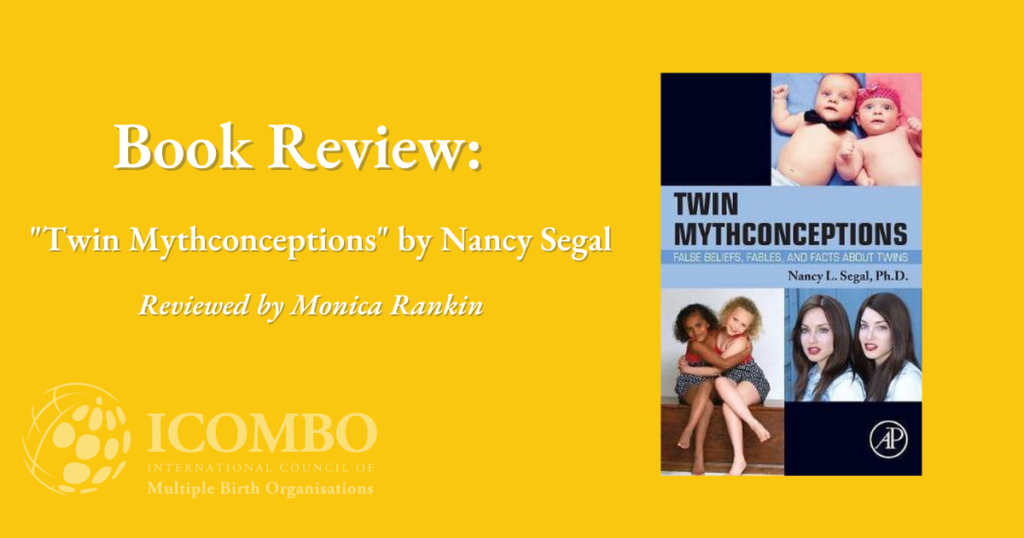
By Nancy Segal
Review by: Monica Rankin
Nancy Segal is a renowned psychologist specialising in the study of twins. Part of the book dedication reads “For twins, triplets, and more who do so much for science just by being themselves” and this reveals the importance of twins and multiples to the research community.
Nancy looks over 80 different myths, misconceptions and beliefs about twins and shows how twin research can support or debunk them. For each premise, she provides a short response and then explains in detail the reason for this response. In each case, the reasoning is supported by research. For many responses, Nancy also includes personal anecdotes – about herself or about twin families she has encountered.
Why did Nancy write the book? “Mostly, I wrote Twin Mythconceptions because of the abundance of misinformation and misunderstandings regarding twins. This book is for anyone who has ever wondered why identical twins show similarities and differences, which couples are likely to have twins, if separating twins at school is a good idea, or if females with twin brothers are different from females with twin sisters.
Twins, families, researchers, physicians, and anyone with a taste for multiple birth facts and figures should find interesting and meaningful material.”
As a parent of twins, with a passion for twins and multiples, and their related research, I found this book to be an excellent read. It was easy to read, with explanations in plain speaking English, that the lay person can understand. For those who want even more depth, Nancy provides an extensive list of research papers that cover every topic. I am sure I will be referring to this book often as a reference tool.
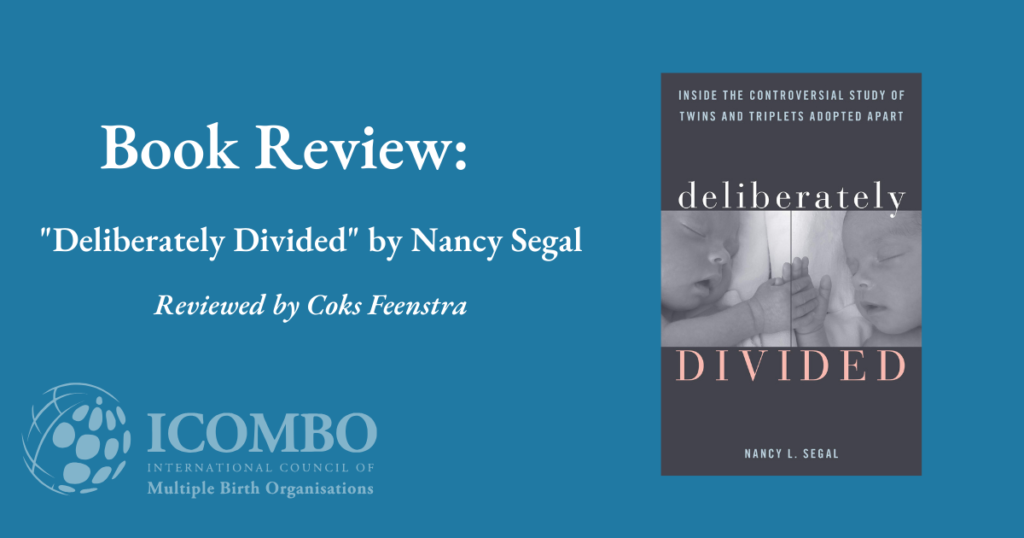
By Nancy Segal
Review by: Coks Feenstra It first appeared in “Meerlingen”, the quarterly publication of the Dutch Multiple Birth Association.
In this book, Segal discusses a thorny subject: the willful separation of twins and triplets upon adoption in the 1960s-80s. Eleven identical multiple babies, 4 twins and 1 triplets, grew up alone. The adoptive parents were not told that their baby was one of multiple births.
However, they were expected to participate in a study into the development of their child, a condition for adoption. The children were followed until the age of 12. In fact, the nature-nurture relationship was studied, the question of what influences our behaviour most: genes or nurture.
How could this experiment take place? That twins were separated and their parents deceived? Why were fraternal twins also separated that were not studied (6 pairs)? How many more twins suffered this fate? These are the questions Segal asks.
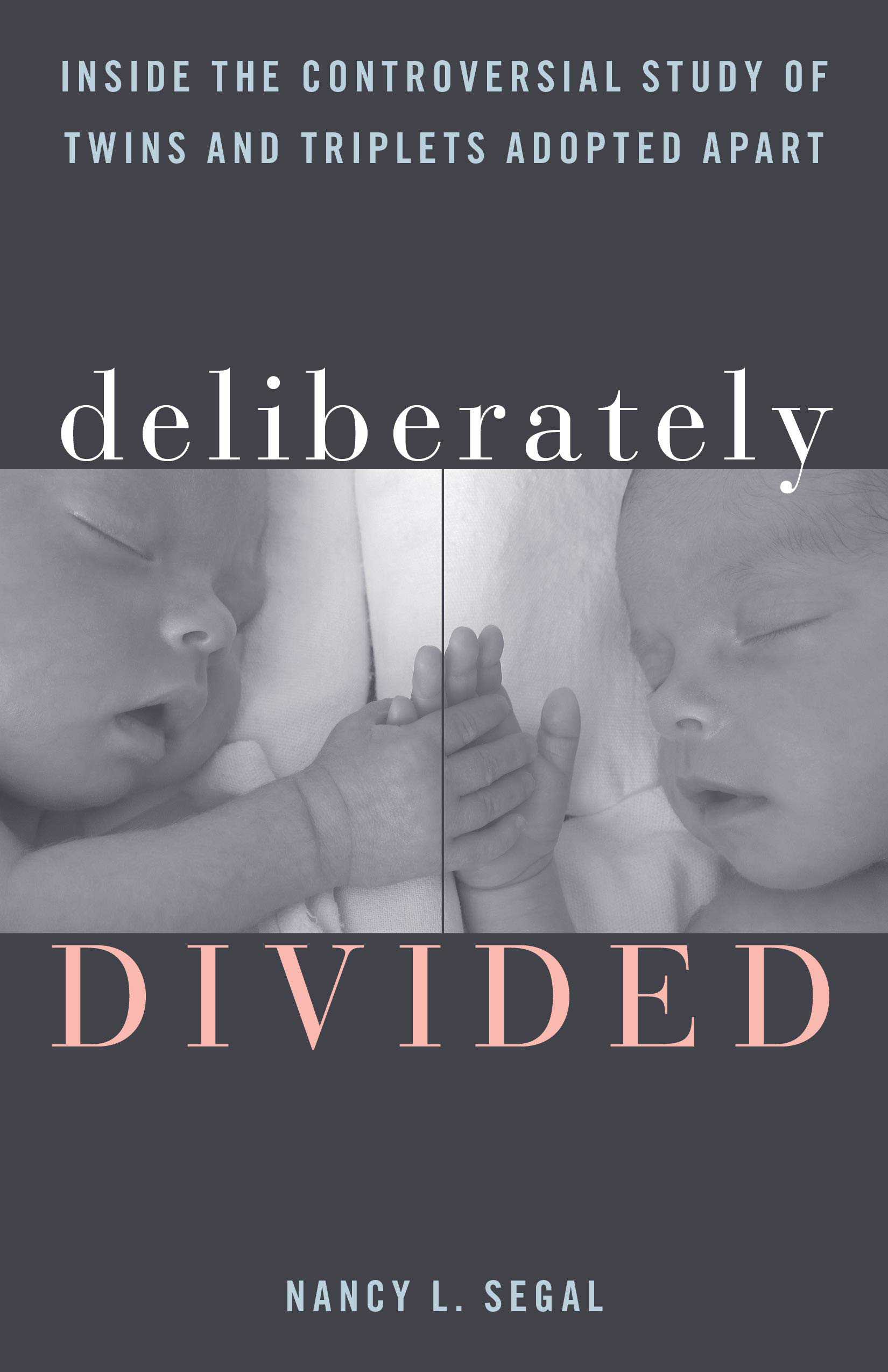
Nancy Segal is a dedicated twin studies researcher for whom the scientific rigour is above all else. In addition, she is a twin herself, so her involvement is professional and personal. Segal does a thorough investigation of all the possible factors that led to this happening and she interviews everyone who has been involved in one way or another, directly or indirectly, in search of answers. She barely finds it.
The investigation is shrouded in mystery. Louise Wise Services (LWS), led by psychiatrist Viola Bernard, was the adoption agency that arranged the placement of the children and partnered with New York University psychiatrist Peter Neubauer. This study is known as the LWS-CDC study. The Child Development Center conducted the research. Were they blinded by the “perfect” opportunity to track from the very beginning identical twins who didn’t grow up together? An investigation was perfect in theory, but immoral in practice, in the words of Segal. Was that also the reason that nothing has been published, that Neubauer’s planned book never saw the light, and that the data is locked in Yale University until 2065? Probably.
Bernard was convinced that twins can develop their identity better if they grow up separately from each other. In addition, she believed that raising twins was stressful for parents. These arguments justified the study at a time when sibling splitting upon adoption was not yet properly regulated. So what happened was not legally punishable, but absolutely unacceptable morally and ethically, a violation of family ties.
Segal describes a number of cases of twins finding each other, often through recognition of third parties. This event turned the lives of everyone involved upside down, parents, siblings, uncles, aunts and above all that of the twins themselves. There was almost always an immediate click between them. Most of them formed a beautiful bond and never lost sight of each other. What bound them was the sadness of not growing up together.
But not all twins managed to bond. When disagreements arose, they lacked the experience of arguing and making amends, which twins normally learn in childhood. They lost each other for the second time. They had become ‘Identical Strangers’ for each other because of what had been done to them, such as the title of the book written by the reunited twins Paula and Elyse and the title of the movie about the identical triplets (Three identical strangers).
Three of the 23 people involved committed suicide. This is a high number, as science shows that twins are less likely to commit suicide than singletons, precisely because of their bond. But that has been taken from these twins. The collected data has still not been released in its entirety, despite efforts by the families’ lawyers. That means that this black page in the history of science is not closed. The secrecy continues. Segal’s book, 500 pages long, is a bold attempt at transparency.
By Pia Rockström
Review by: Carolyn Lister
Pia Rockström has worked as a journalist for nearly 25 years. She is the author of two previous books. and writes in interview form as she loves to let a topic be told by many voices. The book was originally published in Swedish in 2022 and has been translated into English by Johanna Björkell.
The loss of one’s twin presents a unique sense of grief in that twins have shared their lives with each other from their very first heartbeats, and often share a special bond. Pia lost her triplet sister Maria shortly after birth. It wasn’t until she was forty that she really faced that loss. When she started researching, she found there was hardly any literature in Swedish on twinless twins. She set about interviewing twins and multiples from various countries, and the book tells their series of stories. It covers interviews with both identical and fraternal twins who have experienced the loss of their co-multiple at birth, during childhood or as an adult. These are moving stories that describe how the interviewees encountered grief and how they found a way forward, sharing deeply personal aspects of their lives and photos. The title “Living for two” alludes to what many lonely twins experience, that they have been given the chance that their twin did not get, and now must live for two. The surviving twin feels an unconscious expectation to take advantage of life and do something meaningful. Many of the twins also feel that they have their dead twin with them as a strength in life.
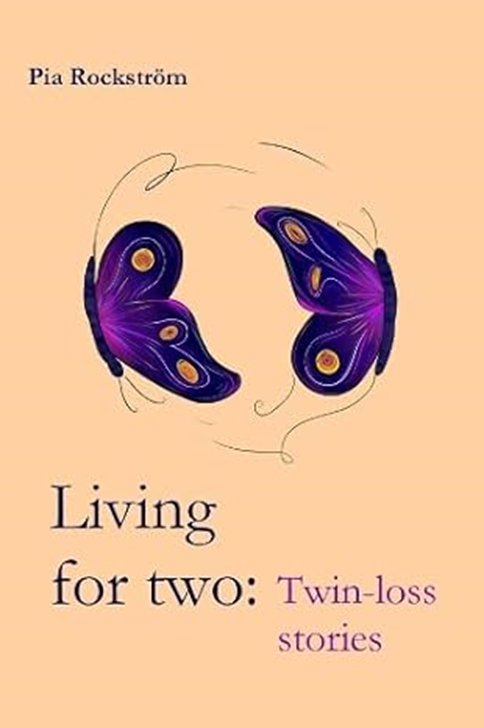
The book is intended as a support for multiples and anyone carrying grief. However, it is very insightful for anyone who deals with multiples and their families coping with loss. Be prepared for a few tears reading this book! One story that really moved me was that of Juliette and her twin sister Beatrice. Beatrice was born with a severe brain injury and died just before their thirteen birthday. This quote from Juliette reflects that despite the grief there is a strength to accomplish more because of their presence: “Beatrice influences my life. She affects who I am today. I can do anything because I had her”.
To find out more about Pia, visit her website here, or her Facebook page here.
You can purchase the book via Amazon here.
by Sharlene Gittens-Francis
Independently published, 13 October 2020; ISBN: 9798690860479
Reviewed by Carolyn Lister
Sharlene Gittens-Francis is the mother of triplets and this is her first book. The aim of this book is to help family and friends understand what it is like to be an expectant mother of multiples (MoM). It is a guide as to how to support them to reduce the stress and make the tough pregnancy journey a little easier with some simple, thoughtful gestures.
This book is packed with useful tips and information for grandparents, aunties, uncles, godparents or even neighbours and acquaintances. This insider’s guide provides information on the following:
- Priceless ways to help MoM on her journey
- Over 150 Tips and valuable assistance you can provide
- Insights into what the expectant MoM is going through
- Questions you can ask (or not)
- Responses from surveys of expectant MoMs, friends and family members
- Tips to help her have a happier bed rest period
- Advice on unique situations like shopping, space considerations, must haves, how much to buy, planning the babies’ shower, gift ideas and much more.
You can purchase the book via Amazon here.
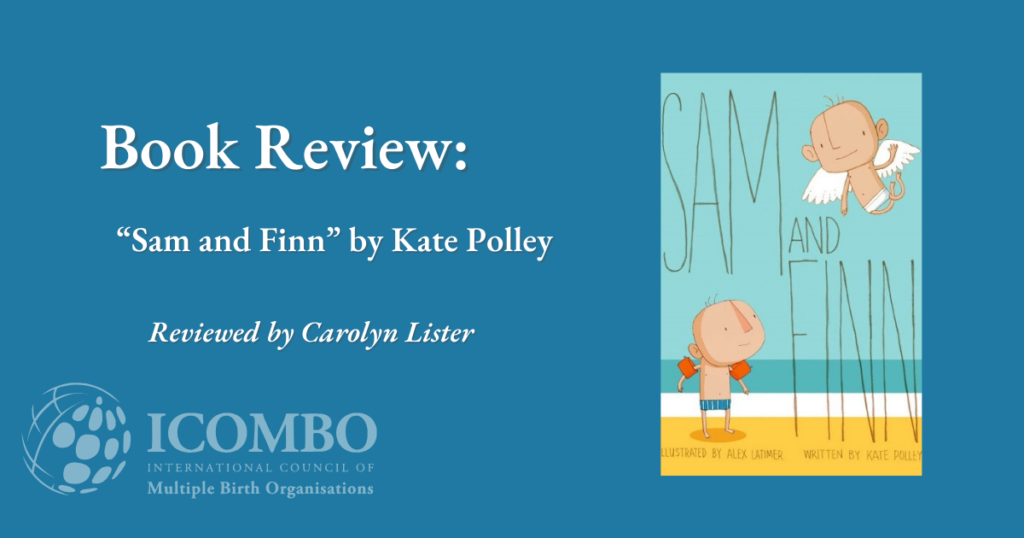
Written by Kate Polley with illustrations by Alex Latimer
First published in 2014 by The Oodlebooks Publishing Company Ltd.; ISBN 9780993056918
Review by: Carolyn Lister
Talking to a surviving twin about loss of his/her co-twin can be very difficult for a bereaved parent. This is a book that would be a helpful way to introduce to a child the fact that they had begun life with a twin brother or sister. Sam and Finn is the story of Kate Polley’s twin sons, one of whom died unexpectedly soon after birth. She wrote the book for her surviving twin, Finn. Sharing Sam’s word through her book and helping other bereaved families is Kate’s passion (see Kate’s Voice).
This is a very touching book that will be helpful for children and families who have experienced the loss of a twin but also any child. Even though not faced with this situation my then 10-year-old twins both read this book and saw the beauty in the story. Sam and Finn’ starts with their life together in the womb and while life and a future are ahead for Finn, the journey for his twin Sam is very different. Despite Sam leaving this world he is still there for his twin. The book is beautifully but simply illustrated also making it appealing to children. Hopefully it will leave them feeling comforted rather than afraid and a sad moment can be turned into a smile by knowing they have their twin still there in spirit by their side.
Versions of the book are also available for loss of twins and triplets (one of more of the babies) as well as more generally the loss of a loved one, including an adult. You can have the books personalised with their names or there is a range of general titles.
‘Sam and Finn’ can be ordered online here.
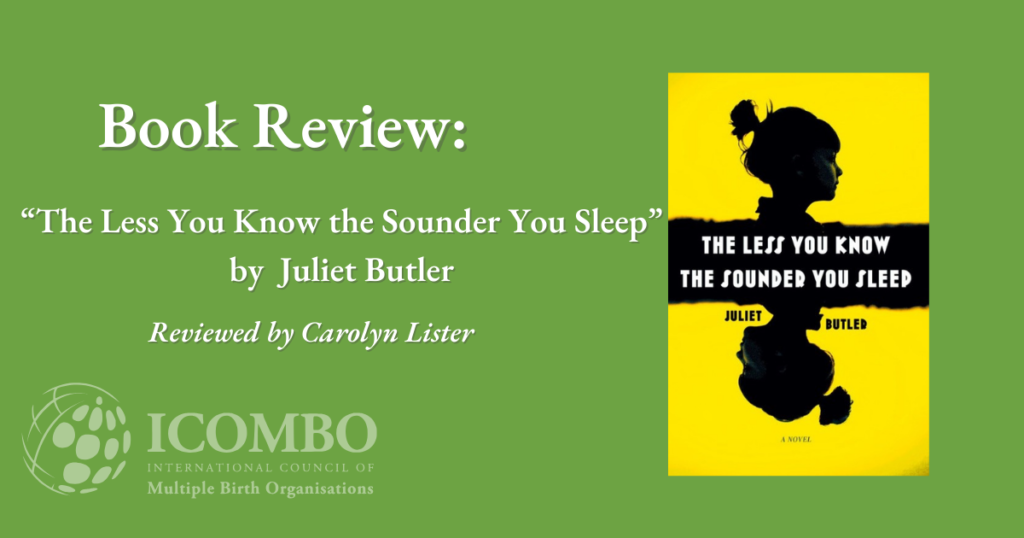
Written by Juliet Butler
HarperCollins Publishers, April 2017; ISBN: 9780008203764
Reviewed by Carolyn Lister
The Joint Fifth World Congress on Twin Pregnancy: A Global Perspective and the 17th Congress of the International Society Twin Studies (ISTS) was held online from the 4th to 6th June 2021 hosted in Beijing, China. The opening keynote talk was a fascinating, but at times sad, one from Juliet Butler about the phenotypic differences in conjoined twins. She talked about her time with Masha and Dasha Krivoshlyapova – Russian conjoined twins who whose childhoods were spent in state-run institutions, where they were subjected to horrific “experiments” performed without their consent. So glad things have moved on since then!
Juliet is a journalist and wrote the book ‘The Less You Know the Sounder You Sleep’ which is a fictionalized account of the lives of the twins. The book is a tale of survival and self-determination, innocence and lies.
‘We’re waiting. I squeeze my eyes shut and dig my fingers into Masha’s neck where I’m holding her. She digs hers into mine. The curtains slowly open. I can’t see anything because the spotlight is on us, bright as anything and blinding me, but I can hear the gasp go up. They always gasp.’
The backdrop of this story is Russia in the midst of political change – through the seismic shifts of Stalin’s communism to the beginnings of Putin’s democracy. This is a very emotional story as the conjoined twins were born in a society where flaws must be hidden from sight, hence them being locked away from public view and subject to inhumane treatment. However, Dasha and Masha strive to be more than just ‘the together twins’. Although the book is at times very sad and heartbreaking with what the twins had to endure also has the of love and hope, with even a little humour. The book is thought provoking and challenges social views of disability and ‘normality’. Well worth a read but be mentally prepared and have the tissues handy if you are anything like me.
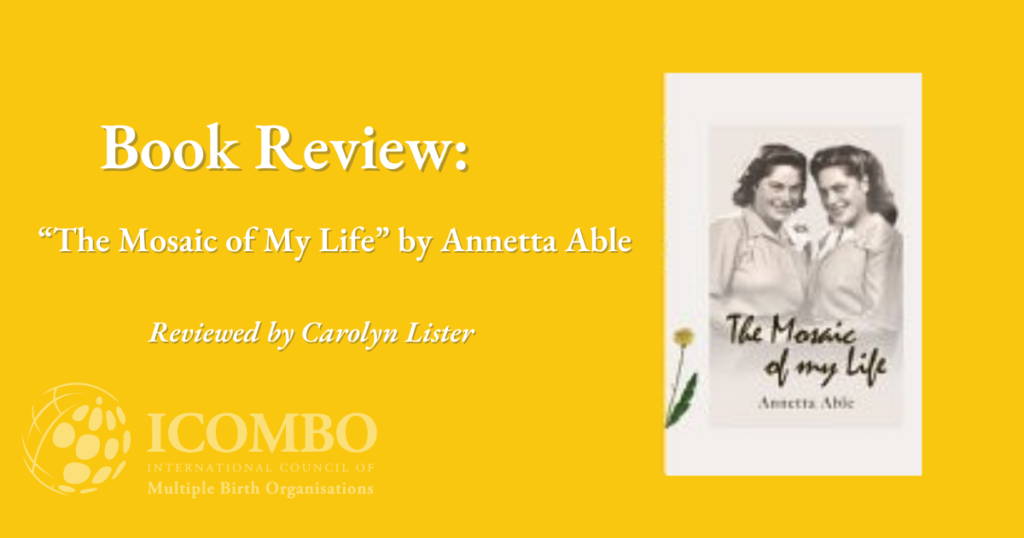
Written by Annetta Able
Inklink Adv Pty, Limited, 31 Mar 2023; ISBN: 9780645341737
Reviewed by Carolyn Lister
Annetta Able and her identical twin Stephanie Heller were born in Czechoslovakia in 1924 and started life in picturesque Prague. Their carefree teen years were cut short by the Nazi invasion. Banned from school and all social activities, they worked in a Jewish orphanage before being transported to Theresienstadt in 1942. The following year they were sent to Auschwitz, where the notorious Nazi Dr Josef Mengele experimented on them. At the end of the war, the pair returned to Czechoslovakia where they learned their entire family had perished. Many years later both twins moved to Australia, with Annetta describing it as the best country in the world.
Over the years the twins have worked hard to ensure that the horrors of the Holocaust would never be forgotten. In 1985, they gave evidence before an international inquiry that found that Mengele should stand trial for crimes against humanity. At the Mengele inquiry the twins met Nancy Segal, who wrote about them for her 2005 book ‘Indivisible by Two – Lives of Extraordinary Twins’.
In 2023 Annetta Able was the author and launched her memoir ‘The Mosaic of My Life’. The book relives her family history and reflects on a life that was interwoven with Stephanie. Although the story is at times harrowing as it describes their time in the extermination camp it is also one of positivity and optimism (wear those ‘rose-coloured glasses’), family and friendship. Annetta talks about the joy she has from her children, grandchildren and great-grandchildren. This story is the twins’ victory over the Nazi regime that sought to annihilate them.